Moonshot AI Drops Kimi K3, Largest Open Model, Rivaling Opus 4.8
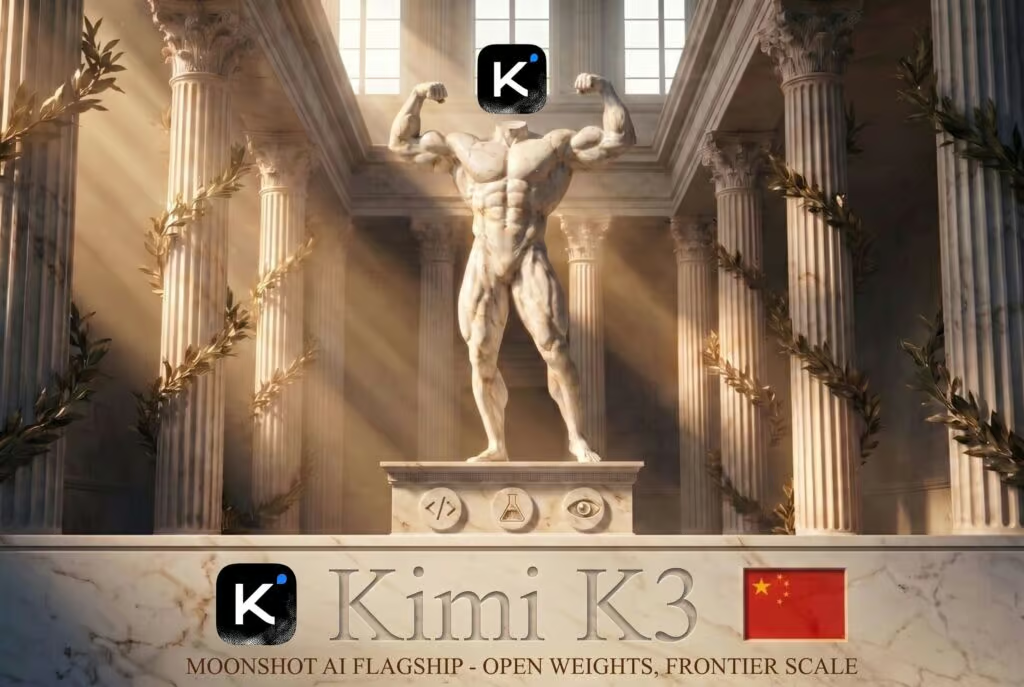
Moonshot AI has released Kimi K3, a 2.8 trillion-parameter open-weight language model that is now the largest publicly available model in the world. Independent evaluations place it on par with or ahead of Anthropic’s Opus 4.8 and OpenAI’s GPT-5.5, with a commanding #1 ranking on the Frontend Code Arena and a 57 on the Artificial Analysis Intelligence Index. The full model weights are scheduled for release on July 27, 2026.
Why It Matters
The open-source AI landscape has been playing catch-up with proprietary frontier models from Anthropic and OpenAI. Kimi K3 changes that calculus. For Moonshot AI, the Beijing-based startup backed by Alibaba, the release is a dramatic comeback. After early traction in 2024 with its Kimi platform, the company was severely disrupted by DeepSeek’s low-cost R1 model in early 2025. Moonshot’s monthly active users in China slid from third to seventh place, and the company pivoted hard to open-source. K3 is the culmination of that pivot, arriving just ahead of the 2026 World Artificial Intelligence Conference in Shanghai.
Chinese AI firms are increasingly using open-source releases to build global developer communities and counter U.S. technology restrictions. As Reuters noted, the strategy allows companies to "showcase their technological capabilities and expand developer communities as well as their global influence, a strategy likely to help China counter U.S. efforts to limit Beijing’s tech progress." Moonshot’s decision to open-source a model at this scale is both a technological statement and a geopolitical chess move.
What’s New and How It Works
Kimi K3 packs 2.8 trillion total parameters, a 1-million-token context window, native multimodal input (text and images), and an always-on reasoning mode the company calls "thinking mode." The architecture introduces two key innovations published as open research by Moonshot’s team. Kimi Delta Attention (KDA), a hybrid linear attention mechanism, enables up to 6.3x faster decoding in million-token contexts. Attention Residuals (AttnRes) serves as a drop-in replacement for standard residual connections, delivering roughly 25% higher training efficiency at only 2% additional cost. The model also employs a LatentMoE architecture with just 16 activated experts out of 896, giving an activation ratio under 2%, and a new activation function called SiTU (Sigmoid Tanh Unit).
To make inference practical at this scale, Moonshot contributed a KDA prefix caching implementation directly to the vLLM project, ensuring day-0 support. The company’s earlier Mooncake project, which won Best Paper at FAST 2025, pioneered KV-cache-centric disaggregated serving that helps run models of this size efficiently. Moonshot recommends deployment on supernode configurations with at least 64 accelerators for best inference performance.
The Numbers
- 2.8 trillion parameters, making it the largest open-weight model ever released
- 1 million token context window with native visual understanding
- 1,687 on GDPval-AA v2, behind only Claude Fable 5 Max and GPT-5.6 Sol Max, ahead of Opus 4.8 (Artificial Analysis)
- #1 on Frontend Code Arena with 1,679 points and a 76% pairwise win rate, jumping from #18 previously (Arena)
- 57 on the Artificial Analysis Intelligence Index, comparable to Opus 4.8 and GPT-5.5 but behind Fable 5 and GPT-5.6 Sol
- 53% on AutomationBench-AA, #1 (Artificial Analysis)
- 1,547 on AA-Briefcase, second only to Fable 5 Max (Artificial Analysis)
- 91.2 out of 100 on BrowseComp, a long-horizon information-seeking benchmark
- Average cost per Intelligence Index task: $0.94, versus $1.80 for Opus 4.8 (Artificial Analysis)
- Pricing: $3 per million input tokens, $15 per million output tokens, with cached input at just $0.30 per million
"Parameters are like neural connections in the human brain, and nearly 3 trillion of them means the model can store more knowledge and patterns in its brain, understand more, think deeper, and answer more accurately."
Moonshot AI executive, via Xinhua
With K3, open-source AI is no longer playing catch-up; it is trading blows with the best proprietary models from Anthropic and OpenAI.
What Comes Next
The full model weights land on July 27, 2026. Once released, developers and enterprises will be able to fine-tune, self-host, and build proprietary systems on a frontier-class base without being locked into API contracts. Moonshot has already demonstrated what sustained autonomous operation can look like: in a proof-of-concept, K3 spent 48 hours designing a functional chip, completing the entire pipeline from architecture to verification on its own, producing a 4 mm² chip that hit timing closure at 100 MHz and could decode more than 8,700 tokens per second in simulation. Another demo saw the model reproduce a complex astrophysics calculation that normally takes a senior researcher one to two weeks in about two hours.
Alongside the model, Moonshot updated its open-source coding agent, Kimi Code, to versions 0.25.0 and 0.26.0, adding background tasks, plan mode, and nested subagent support. The company’s Mooncake serving infrastructure and vLLM collaboration signal that making inference affordable at this scale remains a priority.
What This Means for You
For teams building on AI, Kimi K3 offers frontier-level reasoning at mid-tier pricing, and the open weights create new options for data-sensitive deployments. The $0.94 per-task cost undercuts GPT-5.6 Sol and Opus 4.8, while the 90% discount on cached input tokens makes repetitive, long-context workflows dramatically cheaper. Developers already integrated with OpenAI SDKs can switch to Kimi K3 using the same API format, lowering migration friction.
However, running a 2.8 trillion-parameter model is not trivial. It demands substantial GPU clusters, and the energy demands of inference at this scale feed directly into broader infrastructure debates. Public opposition to data centers is surging, and surveys show many communities prefer nuclear plants over local AI data centers. Organizations that self-host will need to navigate both hardware costs and siting realities, making cloud API access a pragmatic first step for most.
The Bigger Picture
Kimi K3 resets expectations for what open-weight models can achieve. It proves that the gap between open-source and closed-source AI has narrowed to the point of practical parity in many real-world tasks. As the weights go public, the next phase of innovation may not belong to any single lab, but to the global developer community that can now build, audit, and extend a model that just months ago would have been unthinkable outside a handful of corporate vaults.
FAQ
What is Kimi K3 and when do weights release?
Kimi K3 is Moonshot AI’s 2.8 trillion-parameter open-weight language model, the largest publicly available model in the world. Full model weights are scheduled for release on July 27, 2026.
How does Kimi K3 compare to Opus 4.8 and GPT-5.5?
Kimi K3 scored 57 on the Artificial Analysis Intelligence Index, comparable to Opus 4.8 and GPT-5.5 but behind Claude Fable 5 and GPT-5.6 Sol. It hit #1 on Frontend Code Arena with 1,679 points and a 76% pairwise win rate, and topped AutomationBench-AA at 53%.
How much does Kimi K3 cost to run?
API pricing is $3 per million input tokens and $15 per million output tokens, with cached input at $0.30 per million. Average cost per Intelligence Index task is $0.94, versus $1.80 for Opus 4.8. Self-hosting requires substantial GPU clusters and is recommended on supernode configurations with at least 64 accelerators.
Sources
- Moonshot AI – Kimi K3 official blog
- Kimi Delta Attention (KDA) paper
- Attention Residuals paper
- Artificial Analysis Kimi K3 evaluation results
- Arena Frontend Code Arena results for Kimi K3
- vLLM KDA prefix caching support
- Reuters: China weighs silicon curtain around AI models
- Xinhua report on Moonshot AI’s Kimi K3