Amazon Discloses 2.5 Billion Gallons of Data Center Water Use, Claims 7x Efficiency
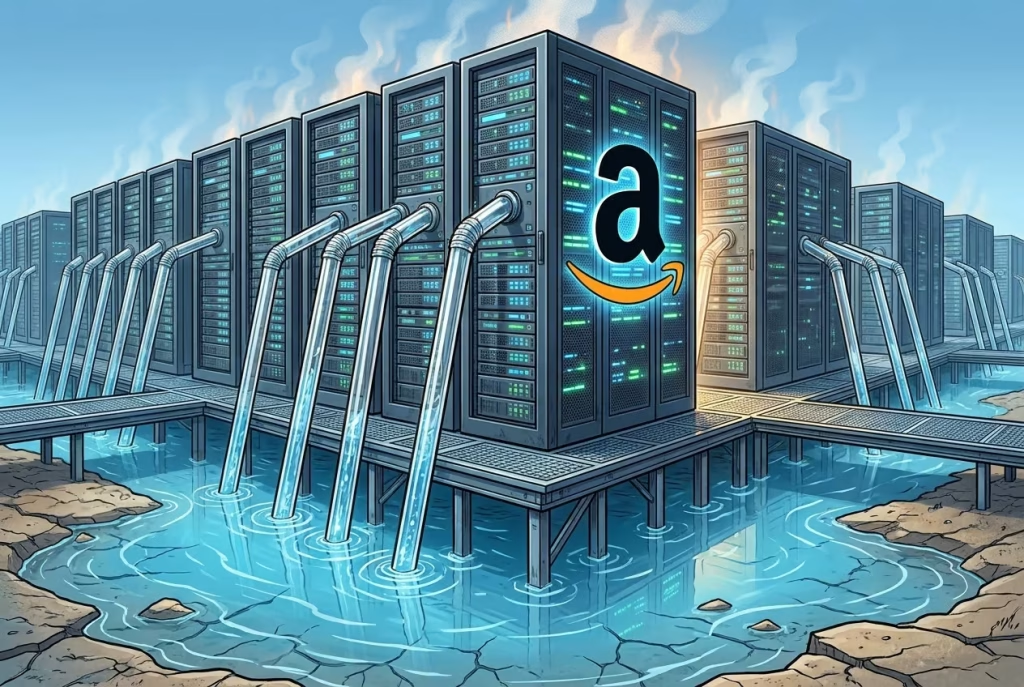
In 2025, Amazon voluntarily published that its global data centers consumed 2.5 billion gallons of water, along with a claim that its facilities are 7 times more water-efficient than the industry average. The disclosure, posted on Amazon’s corporate sustainability blog, covers a fleet of more than 924 facilities worldwide and arrives as AI-driven data center expansion collides with growing public scrutiny of water use in stressed regions.
What Amazon Actually Disclosed
The 2.5-billion-gallon figure covers Amazon’s entire global data center fleet, which the company puts at more than 924 facilities worldwide. Amazon paired the number with a claim that its data centers are 7 times more water-efficient than the industry average, citing internal engineering data and third-party audits of utility water meters as the basis for the calculation.
Alongside the headline number, Amazon detailed the strategies it credits for keeping consumption down:
- Air cooling by default. The company says its data centers rely primarily on outside air for cooling and switch to water-based cooling only during the hottest days of the year.
- Reclaimed water. Amazon reports operating 26 facilities on 100 percent reclaimed water drawn from wastewater treatment plants rather than drinkable municipal supplies, with 130 additional reclaimed-water facilities under contract.
- A water-positive target. Amazon has committed to returning more water to communities than it consumes across its data center operations by 2030, and reports reaching 75 percent of that goal.
The Comparison Amazon Wants You to Make
The disclosure included a deliberately disarming comparison. Citing EPA data, Amazon noted that Americans use roughly 3.3 trillion gallons of water annually on lawns and gardens. By that measure, landscape irrigation in the United States uses more than 1,300 times the water consumed by Amazon’s entire global data center fleet.
The framing is accurate, and it is also strategic. It anchors the conversation to residential water use, a category most readers feel some personal responsibility for, rather than to the concentrated local impact a single hyperscale facility can have on the watershed around it. A data center that draws millions of gallons a day from one municipal supply is a different problem from lawns spread across a continent, even if the aggregate gallons favor the data center.
Why the Disclosure Happened Now
Amazon is not the only hyperscaler with significant water demands. Google, Microsoft, and Meta all run AI and cloud infrastructure that consumes water for cooling, and all have faced community pushback in water-stressed regions where new facilities are being built. What sets Amazon’s move apart is the reporting that preceded it: internal strategy discussions had surfaced showing the company weighing whether to keep water figures out of public view at all.
Publishing the number is a reversal of that posture, and it reflects a broader shift. As AI workloads drive a building boom in data centers, the infrastructure cost of computing is becoming too large and too geographically concentrated to stay invisible. Water permits, municipal partnerships, and local opposition are now part of the cost of expansion, which means transparency is becoming a competitive and regulatory necessity rather than a nicety.
How Should the Numbers Be Read?
Amazon’s figures are self-reported and, in places, hard to verify independently. The “7x more efficient than industry average” claim is the clearest example. Providers measure water efficiency differently: Google reports a metric specific to its AI-focused data centers, while Amazon’s figure spans its full fleet of both traditional and AI workloads. Without a standardized reporting framework, cross-company comparisons remain apples to oranges.
The water-positive commitment carries its own caveats. Returning more water than you consume depends on reclaimed-water infrastructure and watershed restoration projects, both of which require municipal partnership and capital. Scaling from 26 reclaimed-water facilities to more than 150 globally is a logistical and political challenge that engineering targets alone do not solve, particularly in the arid regions where new capacity is increasingly being sited.
What It Signals for the Industry
Amazon’s disclosure is unlikely to be a one-off. The AI infrastructure boom is colliding with the same supply-chain transparency demands that reshaped fashion, food, and electronics over the past two decades. Once one major player publishes a number, silence from the others becomes its own data point. Expect water and energy disclosures to become a standard part of how hyperscalers report, and a standard part of how communities, regulators, and customers evaluate them.
For businesses that depend on cloud infrastructure, the practical takeaway is modest but real: the environmental footprint of the compute you rent is becoming measurable and, increasingly, public. That visibility is now a factor worth understanding when choosing providers and when answering the sustainability questions your own customers are beginning to ask.
The Real Story
The 2.5-billion-gallon figure is not really about water. It is about the end of an era in which the physical cost of digital infrastructure could stay hidden behind a clean interface. AI has made that cost large enough, and concentrated enough, that it can no longer be left off the books. Amazon chose to put its number on the table, framed in the most favorable light it could manage. The more important development is that the table now exists at all.
FAQ
How much water do Amazon’s data centers use?
Amazon disclosed that its global data center fleet, more than 924 facilities worldwide, consumed 2.5 billion gallons of water in 2025, the first time the company has voluntarily published a global water figure.
Why is Amazon claiming 7x water efficiency?
Amazon says its data centers are 7 times more water-efficient than the industry average, based on internal engineering data and third-party audits of utility water meters. The metric covers Amazon’s full fleet and is not directly comparable to Google, which reports a figure specific to its AI-focused facilities.
How does Amazon’s water use compare to U.S. lawn watering?
Citing EPA data, Amazon noted that Americans use roughly 3.3 trillion gallons of water annually on lawns and gardens, more than 1,300 times the water consumed by Amazon’s entire global data center fleet.