How AI Workloads Are Reshaping Data Center Water Consumption
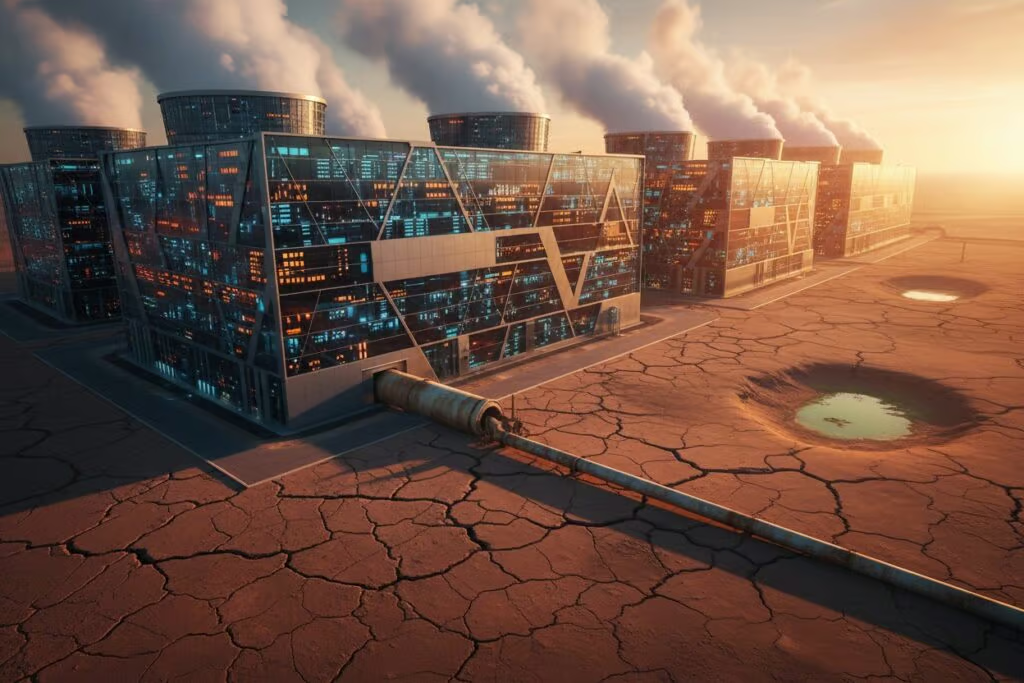
Image Source: naturalnews.com
Artificial intelligence workloads are driving U.S. data center water consumption to roughly one trillion liters per year, with evaporative cooling accounting for a large share of that demand. The buildout is concentrating in water-stressed regions, where local officials and residents are increasingly pushing back.
How big is the increase in data center water use?
Industry analyses cited in recent reporting put U.S. data center water consumption at roughly one trillion liters per year, a sharp rise over prior years. The International Energy Agency has separately found that data centers already use about 415 terawatt-hours of electricity annually, and water demand has tracked a similar trajectory.
Artificial intelligence servers concentrate more power in tighter spaces than traditional compute racks, which raises cooling requirements. Higher power densities translate directly into more water moving through cooling loops, according to utility and trade group assessments.
Why does cooling drive so much of the demand?
Most large facilities rely on evaporative cooling, which releases heat by vaporizing water. A single facility can use millions of liters per day, and the stress on local systems often shows up during peak demand rather than in annual averages.
Industry voices have pointed to technology as a partial fix. Nvidia’s chief sustainability officer, Josh Parker, has stated that a new warm-water cooling system largely solves the water consumption challenge at the data center level. Critics counter that on-site cooling is only one slice of the picture: electricity generation and hardware manufacturing also draw significant water, and those upstream uses are rarely counted in facility-level disclosures.
Where is the strain showing up regionally?
Water-stressed regions have absorbed much of the recent buildout. In Texas, more than 80 data centers have been proposed or built, prompting local officials and residents to question how allocations are made. Central Texas alone saw data centers consume 463 million gallons of water in the 2023-2024 period, according to public broadcasts covering the issue.
Opposition has spread across state lines. Communities in Pennsylvania and California have moved to block or restrict projects, and mayors’ associations have publicly raised concerns about overlapping pressures on drinking water, agriculture, and ecosystems.
What have corporate sustainability reports shown?
Major operators including Google and Amazon released mid-2026 sustainability updates showing that AI expansion has made carbon goals harder to meet. Google’s total emissions rose 25 percent and Amazon’s rose 16 percent, according to those disclosures.
A separate agreement with the Trump administration, the Rate Payer Protection Pledge, commits companies to supplying their own power for new AI data centers so residential electricity bills do not rise. Water consumption was not directly addressed in that pledge.
What is the regulatory and disclosure picture?
United Nations Secretary-General António Guterres has urged AI companies to disclose environmental impacts and commit to renewable-powered data centers as part of a broader energy independence plan. Compliance remains voluntary in most jurisdictions.
At the state level, enforcement has lagged behind reporting requirements. A 2023 Texas law requires data centers to report water usage, but the state’s water supply planning director told lawmakers the agency lacks the power to compel responses. Lawmakers on both sides of the aisle have argued that resource transparency should not be optional.
What should be watched next?
Analysts expect data center water demand to continue rising as AI adoption grows, particularly if no new efficiency standards or location rules are enacted. Industry representatives say cooling innovations should lower water intensity over the next decade, though independent analysts have questioned the pace at which those improvements will reach scale.
The conflict between rapid AI infrastructure buildout and local resource limits is expected to intensify, with state regulators and local communities pushing for clearer reporting, enforceable standards, and stricter siting decisions.
FAQ
How much water do U.S. data centers use each year?
Recent industry analyses cited in reporting put U.S. data center water consumption at roughly one trillion liters per year, with cooling systems driving much of that demand.
Why are AI workloads increasing water use?
AI servers concentrate more power in tighter spaces than traditional racks, raising cooling requirements. Most large facilities rely on evaporative cooling, and a single facility can use millions of liters per day.
Which regions are most affected by data center water demand?
Water-stressed areas have absorbed much of the buildout. In Texas, more than 80 data centers have been proposed or built, and Central Texas alone saw data centers consume 463 million gallons of water in 2023-2024. Communities in Pennsylvania and California have also moved to block or restrict projects.