AI-proctored UNAM exam scrapped after score surge forces 58,000 students to retake test in person
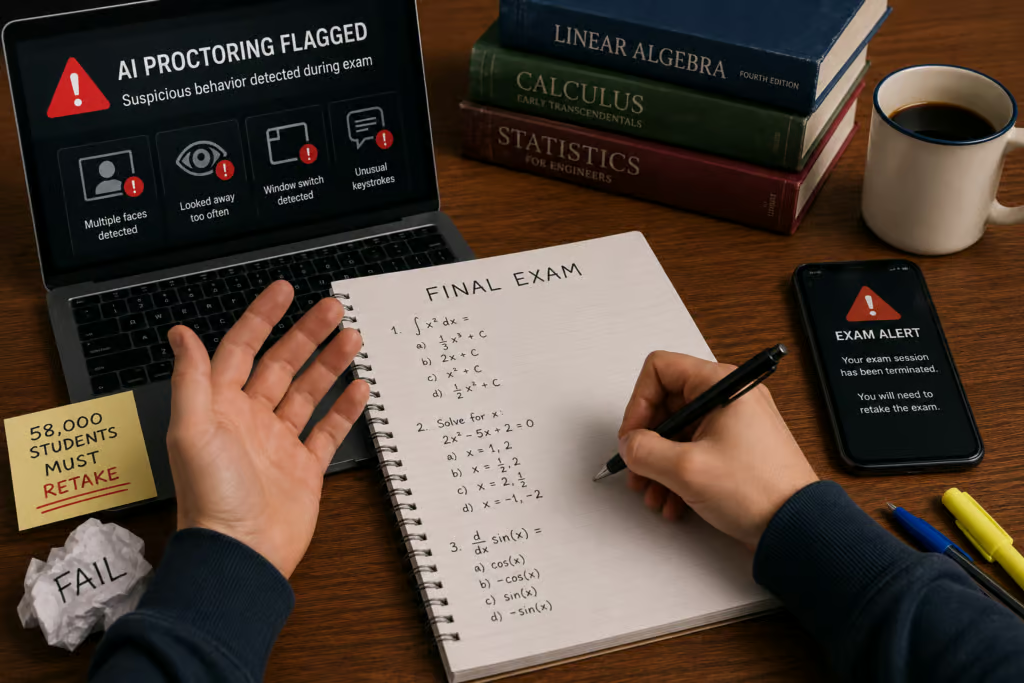
Mexico’s largest university, UNAM, will require roughly 58,000 applicants to retake its undergraduate entrance exam in person after the first fully remote, AI-supervised administration produced a fivefold surge in top scores and prompted accusations of widespread cheating. The university has appointed a new in-person “control exam” and apologized to applicants who followed the rules.
What happened with the UNAM entrance exam?
Earlier in the summer, nearly 160,000 applicants sat for UNAM’s undergraduate entrance exam, the gateway to Mexico’s largest university. For the first time, the test was delivered entirely remotely over several weeks from late May through early June. Students installed a lockdown browser and AI-powered webcam proctoring software on their machines.
When results came in, the distribution looked nothing like previous years, especially at the top end. Between 2021 and 2025, 3.5 percent of test takers scored 100 or higher on the 120-question exam. In this year’s administration, 16.3 percent reached that mark. The gap widened further at the very top: 0.9 percent scored 110 or higher in 2021-2025, compared with 5.5 percent this year. Top scores effectively quintupled.
How is UNAM responding to the suspected cheating?
UNAM commissioned an expert panel, formally called la Comisión Técnica de Personas Expertas para la Revisión del Proceso de Selección de Ingreso a Licenciatura para el Ciclo Escolar 2026-2027/1, to investigate. The panel’s recommendation: administer a new control exam in person, with human proctors, before the start of the school term.
The retake will not only cover this year’s admits. Anyone who would have qualified under minimum program scores dating back to 2021 will also need to sit for the new test, expanding the affected pool to about 58,000 people. Final admissions will now depend on the control exam results.
The university rector has publicly apologized to applicants who did nothing wrong but must now prepare for a second exam, according to Gaceta UNAM, the university’s official publication. The rector also described the retake as “necessary to give certainty and guarantee equity in access.” Details on the control exam were still pending as of the report, with classes currently scheduled to begin August 10, a tight timeline unless the start of the term is pushed back.
What security measures did the remote exam use?
Because the test was remote, UNAM layered multiple controls:
- A lockdown browser from Respondus that prevents printing, copying, switching to other applications, web searches, instant messaging, minimizing the window, and hundreds of other functions during the exam.
- An AI-driven webcam proctoring system from Territorium that flagged signs such as a different person in front of the camera, phone or earpiece use, or the applicant leaving the frame.
- One human supervisor per 150 applicants, who received alerts from the system and could notify UNAM officials about irregularities.
These layers did not appear to catch the bulk of the alleged cheating. UNAM canceled nearly 2 percent of total exams for unspecified conduct issues, but university leadership has publicly acknowledged “the probability that a significant number of applicants may have received help.” An AI researcher quoted by NPR, Raul Rojas, said statistical modeling suggested “that almost half of the students were cheating when taking the exam online.”
What kinds of cheating may have occurred?
The exact methods remain unclear because the exam was multiple choice rather than essay-based, which makes the usual signals of AI cheating, like complete answers pasted into text boxes in seconds, harder to detect. Cheat sheets, leaked questions, and other traditional techniques may also have played a role.
A New York Times report on the scandal noted that cheating tips were circulating widely before the tests went live in spring. Online accounts advised students to position monitors outside the webcam frame where they could run ChatGPT or other AI models. Others suggested hiding earpieces under hair, or paying a third party to take the exam off camera.
What does this say about AI proctoring at scale?
The UNAM case is one of the largest real-world stress tests of AI-supervised remote testing so far, and the result was an institutional decision to pull back to in-person, human-proctored exams for the current admissions cycle. The score jump, the expert panel’s recommendation, and the apology to honest applicants together suggest that UNAM’s leadership concluded the risk of undetected cheating outweighed the convenience of remote delivery for an exam with stakes this high.
For other institutions considering similar setups, the practical takeaways from the published details: a lockdown browser alone does not prevent external monitors or hidden devices, AI webcam monitoring can be circumvented by leaving the frame or staging the camera, and human supervisors at a 1-to-150 ratio may not catch what the software misses. The retake, and the way its results compare with the remote cohort’s, will be the clearest signal yet of how much the remote scores were inflated.
FAQ
How many students are affected by the UNAM retake?
About 58,000 applicants will be required to retake the exam in person. That includes this year’s admits as well as applicants who would have qualified under minimum program scores since 2021.
Why is UNAM making students retake the entrance exam?
Top scores rose sharply compared with 2021-2025, with the share of test takers scoring 110 or higher jumping from 0.9 percent to 5.5 percent. An expert panel concluded that the best response was an in-person control exam to restore confidence in admissions.
What proctoring tools did UNAM use for the remote exam?
UNAM combined Respondus’s LockDown Browser with Territorium’s AI webcam monitoring and one human supervisor per 150 applicants. The combination was not enough to prevent a large surge in top scores.
This article summarizes reporting from arstechnica.com.