Study of 403,000 Prompts Maps the Signals That Drive AI Recommendations for Local Businesses
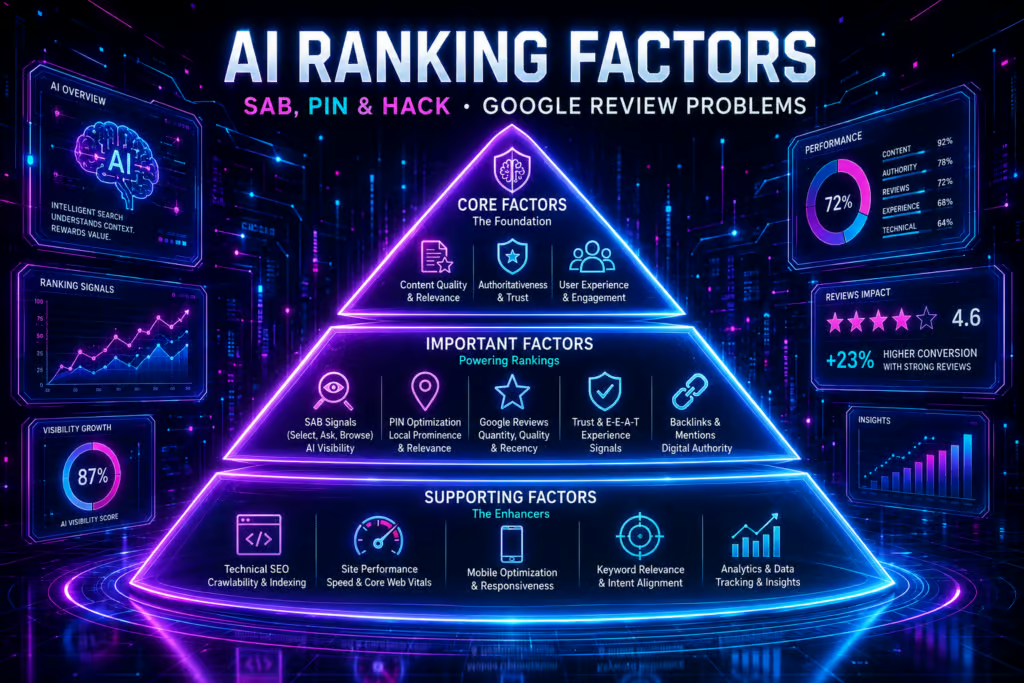
A new analysis of 403,000 prompts run across 10 different AI models set out to identify what correlates with being recommended by large language models, including many local search industries. The strongest signals for the “legal services for businesses” category included appearing in Google search results, having a highly relevant homepage, building backlinks and domain authority, maintaining a Wikidata presence, and earning mentions in relevant Reddit discussions. Across the dataset, simply appearing anywhere on page 1 of Google showed the strongest correlation with AI visibility, suggesting that traditional search visibility remains a leading indicator for AI recommendations.
What the study analyzed
The research, conducted by Ben Wills, examined 403,000 prompts spanning 100 different industries. The goal was to surface the factors that most often show up alongside AI recommendations, with a particular eye on local and service-based businesses. The “legal services for businesses” segment became a focal point because it shares many of the same discovery patterns as local service industries.
The strongest signals for AI recommendations
For legal services providers targeting businesses, the analysis surfaced six signals that consistently correlated with being recommended by AI systems:
- Appearing in Google’s search results, with any page 1 placement showing a strong correlation.
- A homepage that is highly relevant to the services offered.
- Strong backlinks and domain authority from trusted, relevant websites.
- A presence on Wikidata, which is easier to earn than a Wikipedia entry.
- Mentions in relevant Reddit discussions where customers gather.
- Clear service and location information on the homepage.
The single strongest correlation in the data was page 1 ranking in Google. That finding reframes the long-running debate about whether SEO still matters in an AI-first discovery landscape, since the answer, at least in this dataset, is a clear yes.
How to improve AI visibility based on the data
The study translates the correlating signals into practical steps businesses can take:
- Show up in Google’s search results through ongoing SEO work.
- Clearly explain services and location on the homepage so AI systems can parse the offering.
- Earn links from trusted, relevant websites to build domain authority.
- Build a consistent and recognizable business entity across the web.
- Get listed on Wikidata, which has lower editorial barriers than Wikipedia.
- Participate in the Reddit communities your customers use, since Reddit mentions showed up as a measurable signal.
A practical hack for moving an SAB map pin
For service-area businesses (SABs) that do not display a street address, getting the map pin in the right location can be a persistent frustration. A widely shared workaround offers a way to nudge the pin without violating Google’s guidelines.
The technique involves adjusting the service area and related profile settings in Google Business Profile so the marker reflects the geographic center of the intended service zone. Rather than relying on a single radius, the approach uses multiple smaller service areas or carefully configured settings to influence where the pin lands on the map. Because SAB pins are computed rather than manually placed, refining the inputs to that calculation is the only lever businesses have.
Practitioners stress that the goal is accuracy, not gaming the system. A pin that does not represent the real service area can create confusion for customers and may be flagged for review.
Why review management on GBP deserves caution
Google Business Profile (GBP) review management tools can streamline how businesses respond to and request reviews, but they also introduce risk if they automate actions that Google interprets as manipulation. Common warning signs include using review-gating flows that filter out negative feedback, sending bulk review requests from templates that look identical, and replying to reviews from accounts that are not visibly tied to the business.
The safest approach is to request reviews through permitted channels, respond personally and promptly, and avoid any workflow that could be read as filtering or pressuring customers. GBP guidelines have tightened repeatedly, and businesses that rely on aggressive automation have seen profiles suspended with little warning.
Why some Google reviews fail to post
Reviews sometimes vanish after submission, leaving both the customer and the business puzzled. The most common causes include reviews caught by spam filters for containing links or promotional language, reviews posted from accounts flagged for unusual activity, and reviews left on profiles that have been suspended, duplicated, or merged. In some cases, a review simply sits in a pending queue for longer than usual during periods of higher review volume.
Businesses that suspect a legitimate review has been suppressed can flag the issue through GBP support, though resolution times vary. Customers who want to ensure their review posts should avoid links, keep the language specific to the experience, and post from a stable account with a history of normal activity.
What “local brand” actually signals to Google and AI
The phrase “local brand” gets thrown around loosely, but to Google and to AI systems trained on web data, it points to a specific set of signals: a consistent name, address, and phone number across directories, mentions in local news and community sites, citations from regional organizations, and repeated co-occurrence of the business name with a geographic area. These signals help algorithms disambiguate the business from others with similar names and confirm its relevance to a given locality.
AI systems lean heavily on the same structured signals when deciding whether to recommend a business for a local query. A scattered or inconsistent web presence makes that decision harder, while a tightly clustered set of local mentions and citations makes it easier.
The two types of GBP blocks practitioners are watching
Google Business Profile suspensions generally fall into two broad categories: soft blocks and hard blocks. Soft blocks are typically tied to guideline violations that can be corrected through verification, appeal, or profile edits, and they often resolve within a defined review window. Hard blocks are tied to patterns of behavior that Google views as systemic, such as repeated guideline violations, suspicious verification attempts, or evidence of manipulation, and they tend to result in longer suspensions or permanent removal.
Understanding which category a suspension falls into shapes the appeal strategy. Soft blocks usually respond to a straightforward reinstatement request with supporting documentation, while hard blocks often require a more detailed explanation of corrective actions and, in some cases, a longer waiting period before reapplying.
FAQ
What did the AI ranking factors study actually measure?
The study analyzed 403,000 prompts across 10 AI models and 100 industries to identify which signals correlate with being recommended. For the “legal services for businesses” segment, the strongest correlations were page 1 Google rankings, a relevant homepage, backlinks and domain authority, Wikidata presence, and Reddit mentions.
Is SEO still relevant for AI visibility?
According to the data, yes. Appearing anywhere on page 1 of Google showed the strongest correlation with being recommended by AI systems in the dataset, which suggests traditional SEO remains a leading indicator for AI recommendations.
How can a service-area business move its map pin?
Since SAB pins are computed rather than manually placed, the only lever is the underlying service area and profile settings. Practitioners recommend configuring multiple smaller service areas or refining the geographic inputs so the computed pin reflects the intended service zone accurately, without attempting to manipulate the location.
Related coverage
- AI Ranking Factors, SAB Pin Hack, Google Review Problems
- How Semantics and Topical Authority Improve Local SEO for Small Businesses
This article summarizes reporting from .beehiiv.com.