How Local Businesses Get Recommended by AI Assistants

People now ask AI assistants the same local questions they used to type into a map: who fixes roofs near me, which dentist is open on Saturday, where to get a car detailed this week. The assistant answers with a few names. The local businesses that are easy to identify, easy to place on a map and easy to trust are the ones that get named, and every one of those qualities is something local SEO already builds.
Local SEO is the foundation for AI answers
An assistant answering a local question needs the same facts a map result needs: what the business does, exactly where it is, which areas it serves and whether customers are happy with it. Local SEO is the work of making those facts clear and consistent. When that work is done well, an assistant has everything it needs to recommend you.
What an assistant looks for in a local business
- A complete business profile. Accurate categories, hours, services, service area and a clear description.
- Consistent citations. The same business name, address and phone number on every directory that lists you.
- Local pages that answer local questions. A page for each main service, and for each area you serve, written in the words customers use.
- Local structured data. LocalBusiness markup on your site that states your address, hours and the area you serve.
- Reviews that are recent and answered. Signs that the business is active and that someone is listening.
Visibility across your whole service area
A local business does not rank in just one place. It ranks differently at every point in its service area, usually strongest near its own address and often weaker a few miles out. AI answers inherit the same pattern, because they draw on the same local signals.
Measuring visibility across the whole area shows exactly where you are strong and where you are missing. A geo grid runs the same search from many points across your service area and maps your position at each one, so you can see which neighborhoods deserve attention before you decide what to fix.
More than one person’s job
These signals rarely sit with one person. The website belongs to one place, the business profile to another, the directory listings to whoever set them up years ago, and the reviews to whoever talks to customers. The fastest progress comes from putting all of it on one list and working through it in order of impact.
A practical order of work
- Confirm that AI crawlers and search engines can read your website.
- Complete and correct your business profile.
- Make your name, address and phone number match across your citations.
- Add LocalBusiness structured data to your site.
- Build a clear page for each main service and each area you serve.
- Ask for reviews steadily, and reply to them.
FAQ
Do AI assistants use local SEO signals?
Yes. To answer a local question an assistant needs the same facts local search uses: what a business does, where it is, which areas it serves and what customers think of it.
Why does my business show up in some parts of town but not others?
Local visibility changes with the searcher’s location. A geo grid maps your position across your whole service area, which shows exactly where you are strong and where you need more local relevance.
What is the quickest local fix for AI visibility?
Make your business name, address and phone number match everywhere they appear, and complete your business profile. Those two steps remove most of the doubt an assistant has about who you are.
Related coverage
Map your visibility across your service area
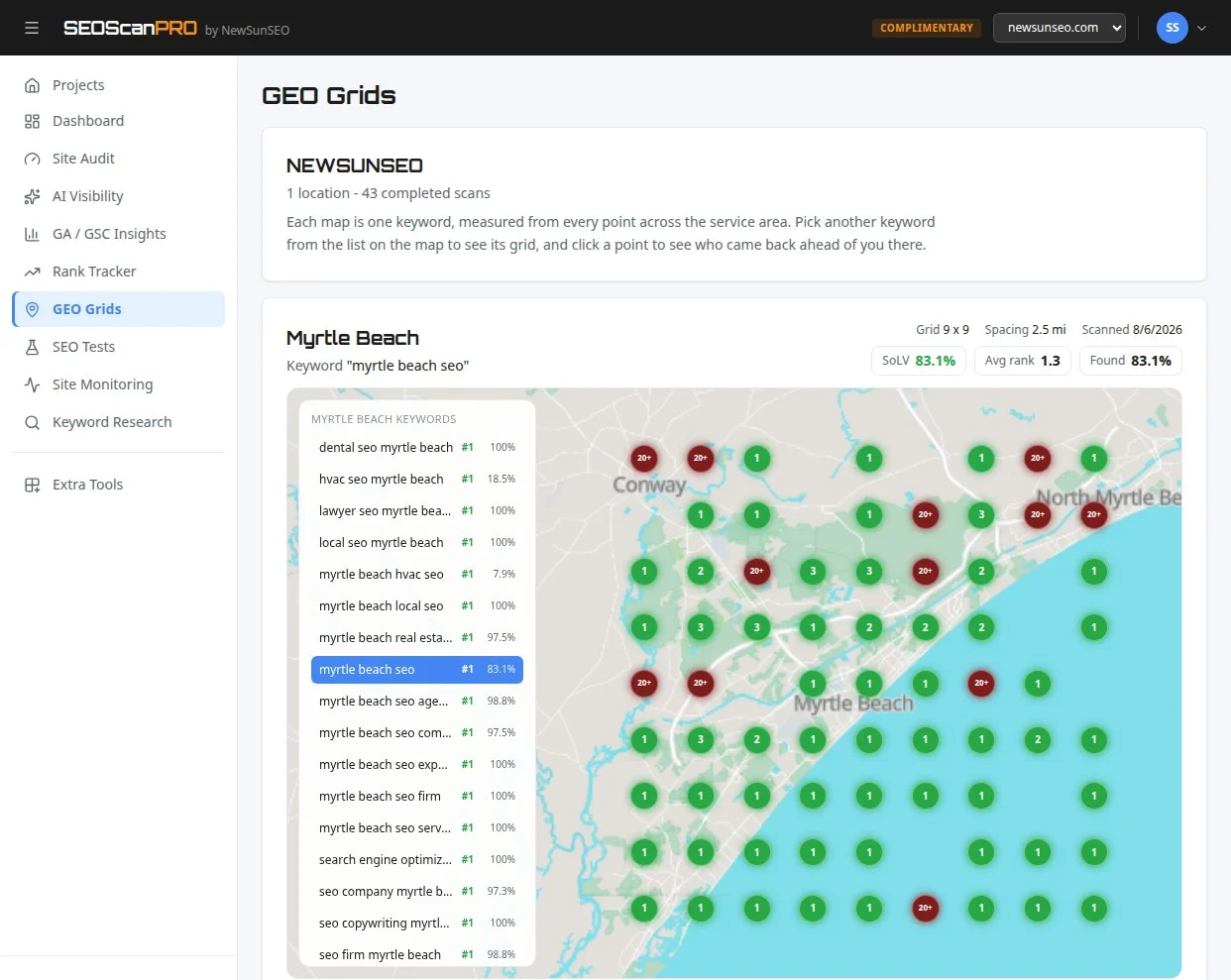
SEOScanPro GEO Grids run the same search from many points across a service area and map the position found at each one. Open GEO Grids.