Google September 2026 Spam Update Impact: What Changed This Week in Search

Publishers and SEOs now have a clear read on the early fallout from Google’s September 2026 spam update, which rolled out in two waves and shook rankings across the web. The week also brought new tests for AI Overviews, a high-profile lawsuit dismissal, several Google Maps and Local Service Ads bugs, and ad platform updates from Microsoft and OpenAI.
How did the Google September 2026 spam update hit sites?
The spam update landed its first major blow over the weekend, with widespread ranking shifts reported across niches. A second phase followed on September 30, producing another round of volatility. Together, the two waves represent the most disruptive spam action Google has run since the Helpful Content updates, and sites that relied on mass-produced or AI-spun content appear to have absorbed the heaviest losses.
Tracking rank movement down to the city level is what makes a geo grid report useful, and SEOScanPro’s GEO Grids map rank position across an entire service area so a business can see exactly which towns and suburbs it dropped out of.
What did the AI contribution report reveal about Google’s publisher payments?
Google’s AI contribution pilot paid roughly 100 publishers an amount that worked out to about 0.1% of their ad revenue. The figure lands far below what most news outlets had speculated when the program was first announced, and it raises fresh questions about whether AI licensing deals will ever match the revenue publishers lose from reduced search traffic.
What is changing in Google AI Overviews and AI Mode?
Several UI and behavior changes are in testing or rolling out:
- AI Overviews have started returning for many large brand-name queries and for sports team rosters, areas where Google had previously been reluctant to show AI-generated answers.
- Citations are being tested at the bottom of AI Overviews rather than the right-hand rail.
- The “Show more” button is being replaced with a “Loading…” label in some experiments.
- AI Mode’s monitoring capabilities have rolled out globally, letting users track follow-ups and saved queries.
- Google has appealed the EU DMA mandate that would force it to share search data with rivals.
- A lawsuit brought by Penske over AI Overviews was dismissed, with the court finding no binding agreement between the publisher group and Google.
What Google Maps and Business Profile changes landed this week?
Three changes stood out:
- Google Maps now requires a sign-in to read all reviews, limiting how anonymous users can browse feedback.
- A map pin bug placed some businesses in the middle of the ocean, affecting a small number of listings.
- Google Business Profiles added a new policy covering misuse of support channels, giving Google fresh grounds to suspend accounts that abuse help resources.
What is going on with Google Local Service Ads?
Two bugs surfaced in Local Service Ads. In one case, the platform served advertisers in locations they do not actually service, exposing advertisers to leads outside their coverage area. In another case, phone numbers were hidden by default and only revealed later in the flow, a change that hurts contact rates for legitimate providers.
What new ad tests did Google, Microsoft, and OpenAI run?
- Google is testing a sponsored products grid designed to look almost identical to the organic product grid, blurring the line between paid and natural results.
- Microsoft Advertising rolled out optimization experiments globally, letting advertisers A/B test campaign settings inside the platform.
- Bing is testing sponsored ads that include a one-line consumer review extension directly in the ad copy.
- OpenAI added bulk product creation and a product review status feature to ChatGPT Ads.
- Google tested removing the “I’m Feeling Lucky” button from the search bar.
- Google marked its 28th birthday with a Doodle that links into an AI Mode quiz.
This week in search, two trends are moving in tandem: aggressive spam cleanup at the ranking layer and new AI-driven ad and answer formats at the interface layer.
FAQ
What is the Google September 2026 spam update?
It is a Google search ranking update that rolled out in two waves in late September 2026, with the first major impact over the weekend and a second phase on September 30. The update targeted spammy and low-quality content, including mass-produced AI material.
How much is Google paying publishers in the AI contribution pilot?
Google paid about 100 publishers an amount that comes out to roughly 0.1% of their ad revenue under the AI contribution pilot program.
Why did Google appeal the EU DMA search data mandate?
Google is appealing the European Digital Markets Act requirement to share its search data with rival platforms. A Google executive said the company feels sad and terrible about the impact on European searchers if the mandate goes through.
Related coverage
- Google Search Console Indexing Report Missing June 2026 Data – LocalSEOBot
- Weekly Search News Recap: AI Local Results Slop, Google AI Home Page Buttons, and Meta Building a Search Engine – LocalSEOBot
- Google Search Console Links Report Not Updated In A Month – LocalSEOBot
SEOScanPro
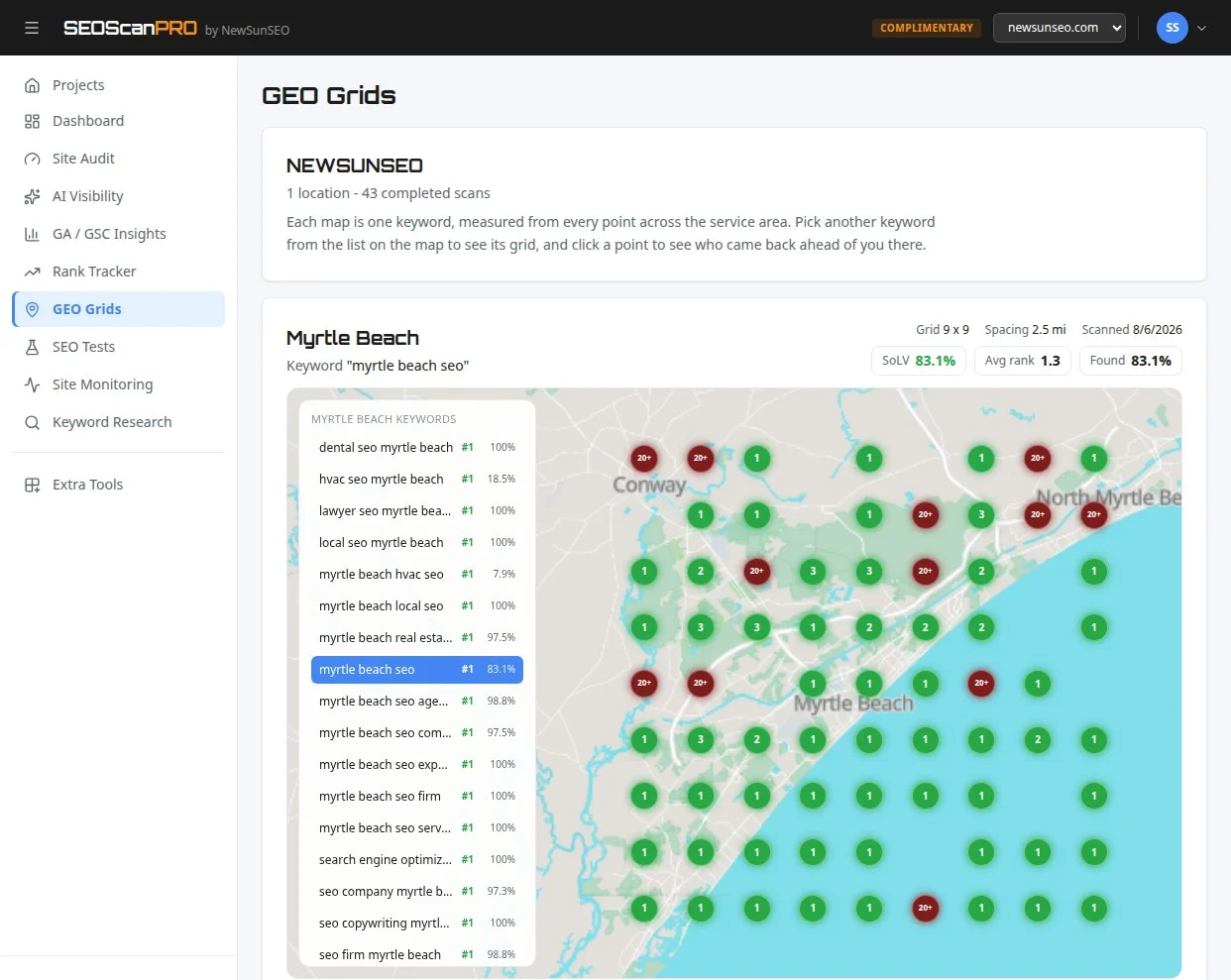
SEOScanPro’s geo grid tool runs a full technical audit of a site and shows the measured result behind every check. Open the geo grid tool.