Google’s Gemini 3.5 Flash Powers the Biggest Search Redesign in 25 Years
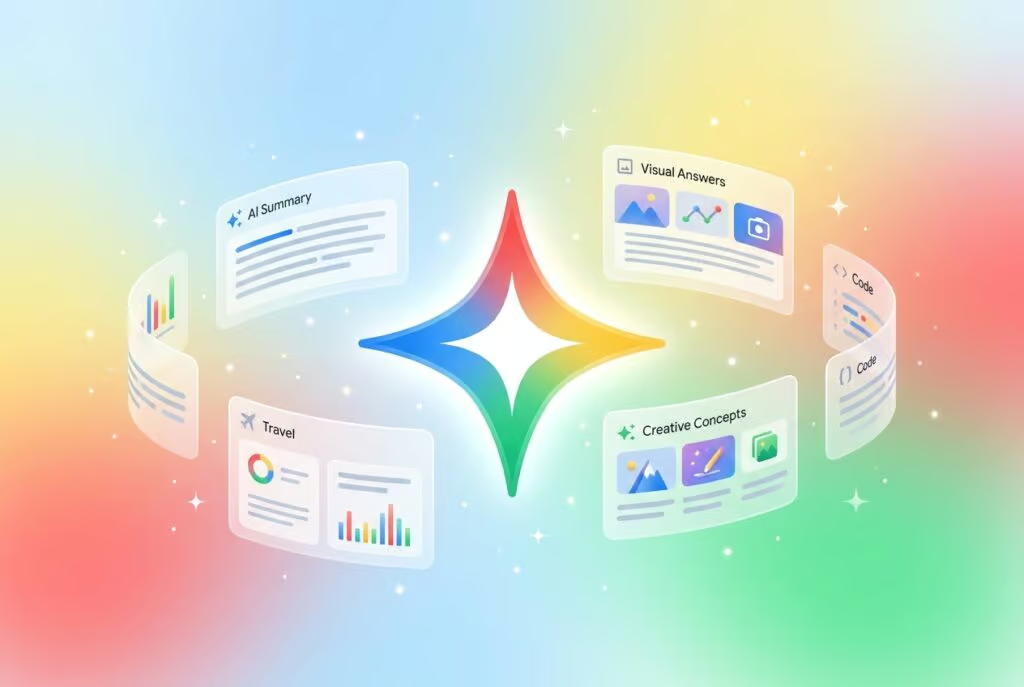
Google rebuilt the most familiar input box on the internet. At its 2026 I/O conference, the company unveiled the biggest Search box redesign in over 25 years, now running on its Gemini 3.5 Flash model by default. The plain keyword field has become a conversational, multimodal surface that accepts files, images, video, and open browser tabs, holds a back-and-forth dialogue, and dispatches agents that work in the background or take actions on a user’s behalf.
What changed at I/O 2026
Google detailed several layers of change, all powered by the newly default Gemini 3.5 Flash model:
- An intelligent input canvas. The keyword field becomes an expanding canvas that accepts text, images, files, videos, and open Chrome tabs. AI-powered suggestions help users assemble multi-part questions instead of guessing at keywords.
- Conversational follow-ups. Any AI Overview can become a thread. A follow-up question carries the prior context forward, with supporting links growing more relevant as the conversation deepens.
- Information agents that run continuously. Users can create agents that scan the web around the clock against specific criteria, then send a synthesized alert when they find a match, such as a product restock or a listing that meets set conditions.
- Agentic booking and actions. Search can book local services, find a venue that meets multiple constraints, or call businesses on the user’s behalf, drawing on real-time availability and review data.
- Generative UI and custom mini-apps. Google’s Antigravity coding agent can build interactive dashboards, trackers, and visual simulations directly in the search page, pulling from live sources such as maps and weather and from user-connected apps like Gmail and Google Photos.
Personal Intelligence, the layer that lets Search draw on a user’s own connected data, has expanded to 98 languages across nearly 200 countries with no subscription required.
The redesign turns the search box from a place where you type keywords into a surface where you hold a conversation, hand off a task, and get back a synthesized answer or a working tool.
From ten blue links to a synthesized answer
The architectural shift is the headline. For 25 years, Search worked as a ranked list of links: you query, it returns pages, you click. The Gemini-powered surface assembles an answer from multiple sources and presents it in place, often without sending a click to any single source. Conversation replaces the new-query-each-time pattern, and agents replace the one-off lookup with a persistent task that runs until it finds what it was told to watch for.
That has a measurable consequence already visible in search behavior. In early 2026, a SparkToro analysis found that 68% of U.S. Google searches ended without a click to an external site, and only 2.8% of search sessions sent a visitor to a social media site. A search surface designed to answer in place, rather than route out, pushes that zero-click share higher. Notably, Google reported an all-time high in overall query volume in the same period: richer answers appear to be increasing how often people search, even as fewer of those searches end in an outbound click.
What is the rollout timeline?
Google is staging the launch rather than flipping everything at once:
- The intelligent Search box rolls out to all countries where AI Mode already operates, starting immediately.
- Information agents arrive first for Google AI Pro and Ultra subscribers over the summer.
- Agentic booking expands to all U.S. users.
- Generative UI and Antigravity-powered mini-apps follow in the coming months, initially for U.S. Pro and Ultra subscribers.
The phasing means the most autonomous features, the agents and on-the-fly app generation, reach paying tiers and U.S. users first, while the conversational box itself spreads broadly and quickly.
What does it mean for anyone publishing online?
When the answer is synthesized rather than linked, the unit of value changes from earning a click to being the source a model selects and cites. Three implications follow directly:
- Machine-readable beats clever. Clear, descriptive language, accurate metadata, and consistent naming help a model parse and trust your content. If an information agent is scanning for a specific term, your content needs to state that term plainly, not bury it behind a cryptic headline.
- Authority is the selection criterion. An AI surface picks sources it can rely on. Consistent, accurate, well-structured content across your owned channels makes you a more likely citation than a one-off page.
- Measurement has to follow the behavior. If users get answers without clicking, traffic counts undersell your actual reach. You need a way to gauge whether AI surfaces are citing you at all, separate from how many visits they send.
The bigger picture
The redesigned Search box is shipping, not demoing. It reads files, holds conversations, runs background agents, and builds tools on the fly, all on Gemini 3.5 Flash. For the open web, the mandate is blunt: content has to be discoverable, machine-readable, and authoritative enough to be the source an AI cites, because the click that used to reward good ranking is no longer guaranteed. Search is becoming a conversational, agentic surface, and the publishers who structure their content for that reality will define the next era of discovery.
FAQ
What is Gemini 3.5 Flash doing in the new Google Search?
Gemini 3.5 Flash is the default model powering the redesigned Search box announced at I/O 2026. It runs the multimodal input canvas, the conversational AI Overviews, the background information agents, the agentic booking features, and the Antigravity-built mini-apps that generate on-page dashboards and simulations.
When does the new Google Search redesign roll out?
The intelligent Search box is rolling out immediately to all countries where AI Mode already operates. Information agents arrive over the summer for Google AI Pro and Ultra subscribers. Agentic booking expands to all U.S. users. Generative UI and Antigravity-powered mini-apps follow in the coming months, initially for U.S. Pro and Ultra subscribers.
Why does this redesign matter for publishers?
With 68% of U.S. Google searches ending without an external click in early 2026, publishers now compete to be the source an AI cites rather than the link a user clicks. Clear, machine-readable content, consistent authority across owned channels, and citation-focused measurement are the levers that determine who shows up in synthesized answers.