Google Confirms Search Spam Team Is Active and Well Resourced

If you run a local business website, it is worth understanding what Google’s spam enforcement is and is not aimed at. Rajan Patel, VP of Engineering for Google Search, confirmed on August 31, 2026 that the search spam team is still well resourced and shipping new spam algorithms. The confirmation followed the August 2026 spam update, which launched August 18 and completed August 21 and reshuffled rankings across a wide range of sites.
What did Google confirm?
The exchange played out publicly on X. An SEO practitioner raised a theory that Google’s search team might no longer be well staffed, with attention shifting toward Gemini, and that scaled low-quality patterns such as "scaled listicles" were ranking as a result. Rajan Patel, VP of Engineering for Google Search, replied: “Yes it is.”
The point for a small site owner is narrow and useful. Google is still writing and shipping the automated systems that demote spam, and those systems are separate from the core updates that reassess overall quality. A site can be caught by a spam update even in a month with no core update.
How hard did the August 2026 spam update hit?
Data produced by SE Ranking showed the August update hit harder than most recent spam updates. During the rollout, 16.71% of URLs that had been ranking in the top 10 fell beyond position 100 for the same keyword, compared with 9.2% during a similar five-day period in July. That is an 82% increase in top-10 URLs dropping out of the top 100, which made a top-10 URL about 1.8 times more likely to disappear from the top 100 during the update than during an ordinary week.
SE Ranking analyzed U.S. organic results for the same 100,000 keywords across 20 industries, comparing rankings from August 17 and August 22 with a baseline of July 26 and July 31. The volatility spanned every niche it tracked, from 74.64% top-10 churn in real estate to 85.55% in fashion and beauty. It was not only losses: SE Ranking also recorded a 12% increase in URLs reaching the top 3 that had not cracked the top 20 before. SE Ranking did not run a URL-level or domain-level analysis, so its data does not show which kinds of sites or tactics were hit hardest.
What kinds of sites were affected?
Analyst Glenn Gabe documented four sites that got hit, and none of the four resembled a small business publishing AI-assisted content with human review. One documented site had scaled to roughly 1.3 million URLs and looked heavily programmatic. Another had close to 250,000 URLs indexed and saw a major decline in the same window.
That fits Google’s own definition of the behaviour it targets. Google Search Central’s spam policies, last updated August 28, 2026, describe scaled content abuse as follows: "Scaled content abuse is when many pages are generated for the primary purpose of manipulating search rankings and not helping users no matter how it’s created." The deciding factor is intent and value, not page count on its own.
The spam updates did not slow down
August was one of four spam updates Google ran in 2026, making it the most active year for spam updates since 2021. Google’s 2026 spam updates finished quickly earlier in the year, at 19 hours and 30 minutes in March and roughly two days each in June and August. The September 2026 spam update ran much longer, finishing on October 8 after nearly 14 days, the longest of the four. Google has not said why it took longer or which tactics it addressed.
Early reads on the September rollout came from site data. Diib published figures from 32,569 websites with connected Google Analytics, comparing each site’s share of unpaid Google search visits against the same days a week earlier. The median share dipped from 34% to 31%, and 10% of sites saw their share cut by half or more, up from 5% in the earlier period. Diib called it "an early read, not a verdict" and noted the data does not reveal which sites Google flagged as spam. SEOmonitor reported that many rank trackers showed sudden changes starting September 26 that searchers did not actually see, which it attributed to incomplete results returned during automated checks.
What this means for your local business website
A clinic, shop or trades site with a modest number of pages a person wrote and checked is not the profile these updates knock down. Using AI to help draft content is not the trigger either. Google’s policy treats AI-generated content as a violation only when pages are made to manipulate rankings and offer little to no value, no matter how they were created.
It is worth checking a local site for scaled page patterns the owner may never have noticed. Auto-generated service-area pages that swap one town name for another, AI-generated near-me pages, and thin duplicated city pages added by a plugin or a past web agency are worth reviewing. Aim for a website built on pages a reader would find genuinely useful.
What to do now
- Compare how many pages Google has indexed with how many you actually wrote. A large gap is worth looking into. Consider running a full technical audit of the site.
- Look for auto-generated city or service-area pages. Open a few, read them side by side, and ask whether anything changes beyond the place name.
- Review any AI-written pages that went live without a human reading them. Keep the ones that answer a real question and rewrite or remove the ones padded only to rank.
- If you saw a drop in late September, use the fixed September 24 to October 8 window to compare Search Console impressions and clicks before, during and after the update. A dip that holds for several days in Search Console carries more weight than a quick swing on a third-party tracker.
- If pages break Google’s spam policies, revise them and give it time. Google notes that its automated systems can take months to recognise that a site now complies.
FAQ
What did Google confirm about its spam team?
Rajan Patel, VP of Engineering for Google Search, confirmed on X that the search spam team is still well resourced and continues to update its spam algorithms to reduce spam in Google Search results.
How big was the August 2026 spam update impact?
According to SE Ranking, 16.71% of top-10 URLs fell beyond position 100 during the update, compared with 9.2% in a July baseline. That is an 82% increase and made a top-10 URL about 1.8 times more likely to drop out of the top 100.
Does using AI on my pages trigger a spam penalty?
Google’s spam policy treats AI-generated content as a violation only when pages are made to manipulate rankings and provide little to no value, no matter how they were created. Using AI with human review and real value is not the trigger.
Related coverage
- Weekly Search News Recap: AI Local Results Slop, Google AI Home Page Buttons, and Meta Building a Search Engine – LocalSEOBot
- Google Search Console Links Report Not Updated In A Month – LocalSEOBot
- Inside Google Maps: 72 Ranking Signals and the Architecture Behind Local Search – LocalSEOBot
SEOScanPro
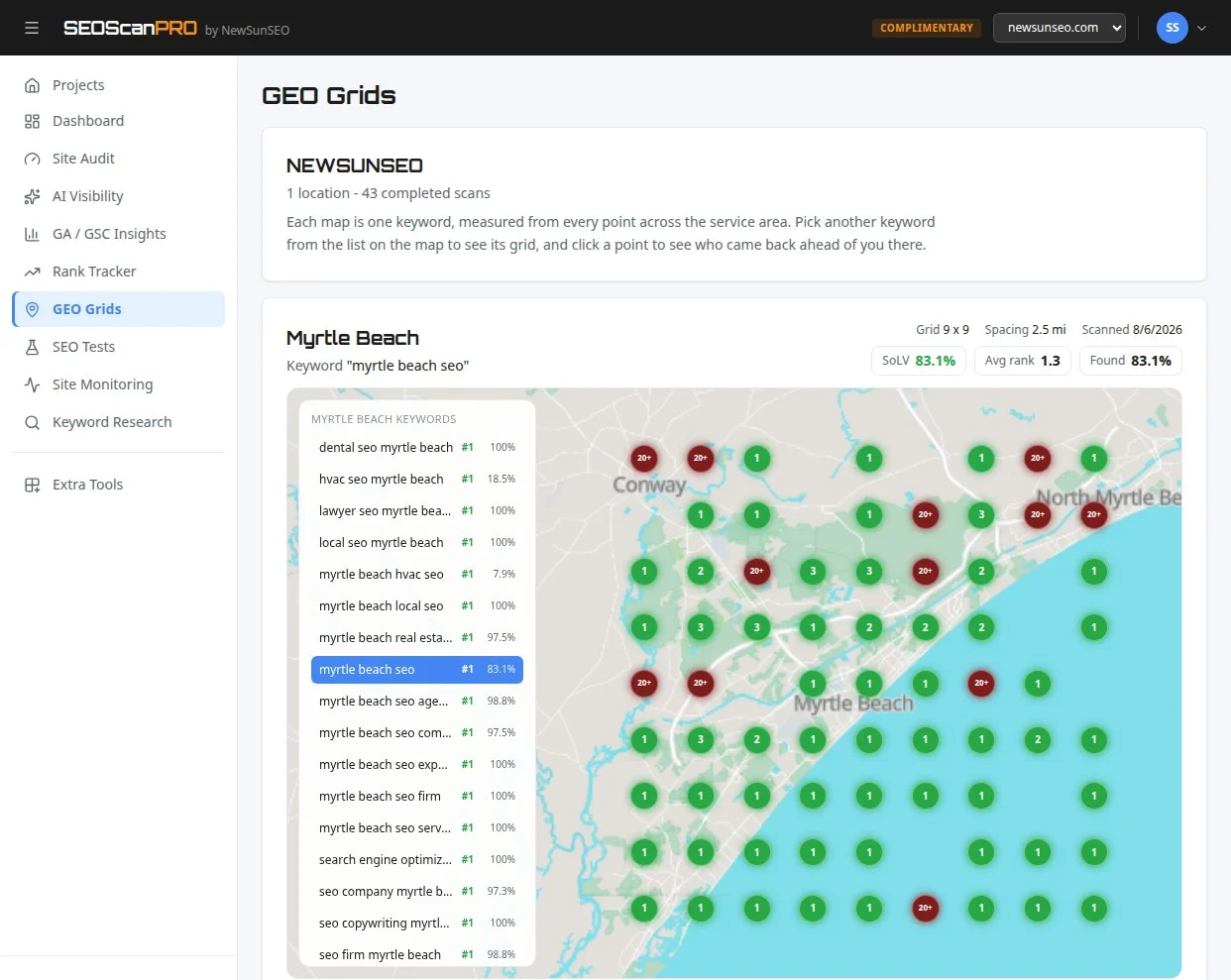
SEOScanPro runs a full technical audit of a site and shows the measured result behind every check. Open the geo grid tool.
Sources
- Google Confirms Search Spam Team Is Fighting & Well Resourced, seroundtable.com, Aug 31, 2026
- searchenginejournal.com
- bradleebartlett.com
- sammobile.com
- Daily Search Forum Recap: August 31, 2026, seroundtable.com, Aug 31, 2026
- gendigital.com
- searchenginejournal.com
- coalitiontechnologies.com
- Google’s August 2026 spam update hit rankings harder than normal, searchengineland.com, Aug 27, 2026
- coalitiontechnologies.com