Four risks hiding in your branded search results and how to audit them
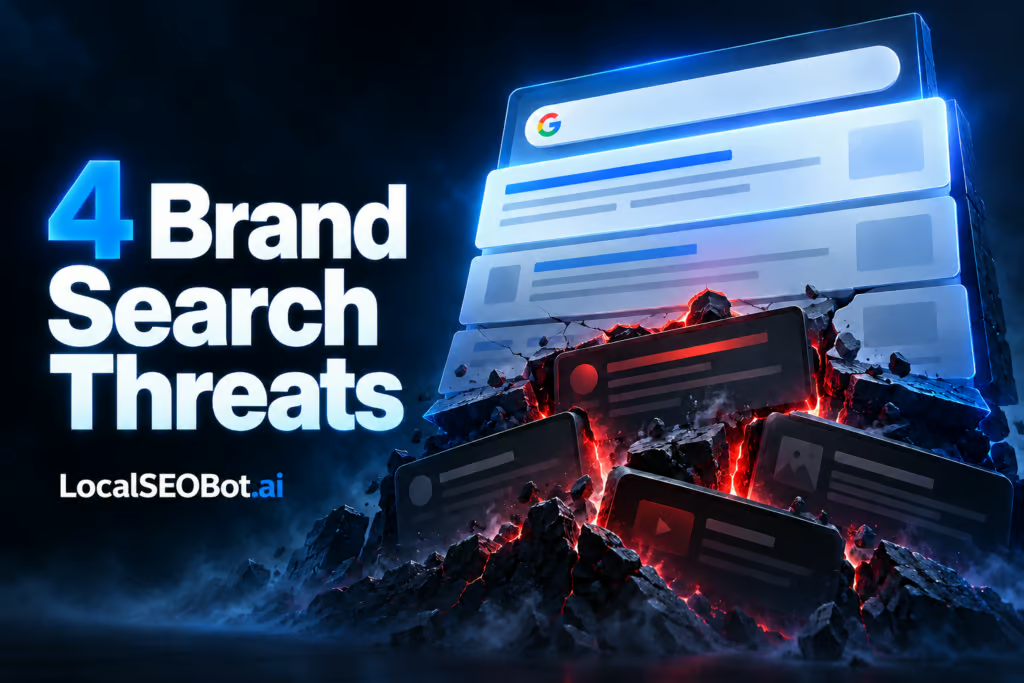
Four risks hiding in branded search results and how to run a risk audit
Branded search results are often the first thing customers see about your company, and the makeup of that page shapes trust, click-through and conversion. When a single search for your brand surfaces only a handful of positive assets, or pushes negative threads to the top, your reputation becomes fragile. A branded search risk audit converts that fragile surface into signals that can be measured, monitored and protected.
What branded search results actually do for your business
Branded searches are queries that include a company or product name, and the results page usually leans heavily toward content about that brand. Because the searcher is already past the discovery stage, a healthy branded results page tends to convert at a higher rate than generic queries. The same page also surfaces third-party review threads, news items, AI summaries and knowledge panels alongside your owned properties, and that mix of external voices is where the risk enters.
Risk 1: You may rely on too few positive results
The first page of Google is no longer simple to influence because many of the ten blue-link slots are now occupied by third-party results rather than owned or directly influenced assets. If a brand’s positive links are concentrated in a small number of pages, a single slip can drag the whole page down, and a thin base of positive assets can also read as inauthentic. The fix is to build out a wide set of positive, authoritative assets on third-party sites, such as review platforms, industry publications and trusted blogs, so visibility holds steady over time.
Risk 2: Negative results are more prominent than ever
Google AI Overviews and ChatGPT-style answers have a habit of pulling negative content to the top, and the same is true for branded queries. One unfavorable Reddit thread, a questionable YouTube review from an influencer, or an outlandish blog post can sit in a position that influences buyers. Watch for negative content climbing from page two onto page one, and for individual threads gaining popularity. Track both traditional search and AI search, and bring in an online reputation management specialist when negative results around your brand start to rise.
Risk 3: Search features can carry consequences
Image results, People Also Ask, autocomplete, news results, Google Discover, Google Trends and Top Stories often get ignored, yet they can reveal as much about a brand as the blue links on page one. These features are harder to access and harder to assess, which is exactly why they are worth the effort. Analyzing them alongside AI Overviews and the standard organic listings gives a fuller picture of how a brand actually shows up.
Risk 4: Your positive results are not diverse enough
Duplicating owned content and dropping brand mentions onto third-party sites is not enough on its own. Real resilience comes from being mentioned on trusted media properties and third-party outlets such as Wikipedia, Reuters and the Associated Press. A varied set of trusted mentions reduces dependence on any single ranking asset, so one lost link or one platform change does not erase your presence.
How to conduct a branded search risk audit
A practical audit has five steps and can be repeated on a regular cadence:
- Identify branded queries. List the brand and product queries your customers actually type.
- Record initial results. Capture page one of Google as it stands, including third-party results and search features.
- Categorize the results. Sort each listing as positive, negative or neutral, and as owned or third-party.
- Track themes and movement. Watch for new themes around your brand and for the rise or fall of specific results.
- Prioritize vulnerability. Rank weak spots by visibility, authority, ranking stability and likely impact on conversion.
For local businesses tracking how a brand appears across a service area, a geo grid report maps rank position town by town, which is the kind of measurement SEOScanPro’s GEO Grids provide, so blind spots in specific suburbs show up instead of hiding inside one city-wide average.
Treat branded search results as an early warning system
A brand that invests in owned pages, third-party coverage and accurate listings can dilute the impact of negative content on search results more effectively than a brand whose first page relies on a small set of well-known links.
FAQ
What is a branded search result?
A branded search result is a search engine listing that appears when a query includes a company or product name. The page is usually dominated by content about that brand and can include owned pages, third-party articles, reviews, AI Overviews, news items, knowledge panels and social threads.
Why are negative results showing up more in branded search?
AI-powered surfaces such as Google AI Overviews and ChatGPT-style answers often pull a mix of sources, which can carry negative threads, Reddit discussions, influencer reviews and opinion pieces to the top of the page. The same dynamic affects branded queries, where a single unfavorable thread can rise into view.
How often should you run a branded search risk audit?
A branded search risk audit should be run on a regular schedule, since new themes can surface at any time and individual results can climb from page two to page one without warning. Many teams pair a deep audit with ongoing monitoring of branded queries, third-party results and search features such as image results, People Also Ask, autocomplete, news results, Google Discover, Google Trends and Top Stories.
Related coverage
SEOScanPro
SEOScanPro’s AI visibility report runs a full technical audit of a site and shows the measured result behind every check. Open the AI visibility report.