The Once and Future Fable #5: Claude Sonnet 5, the Mythos Moment, and the Shape of AI Policy
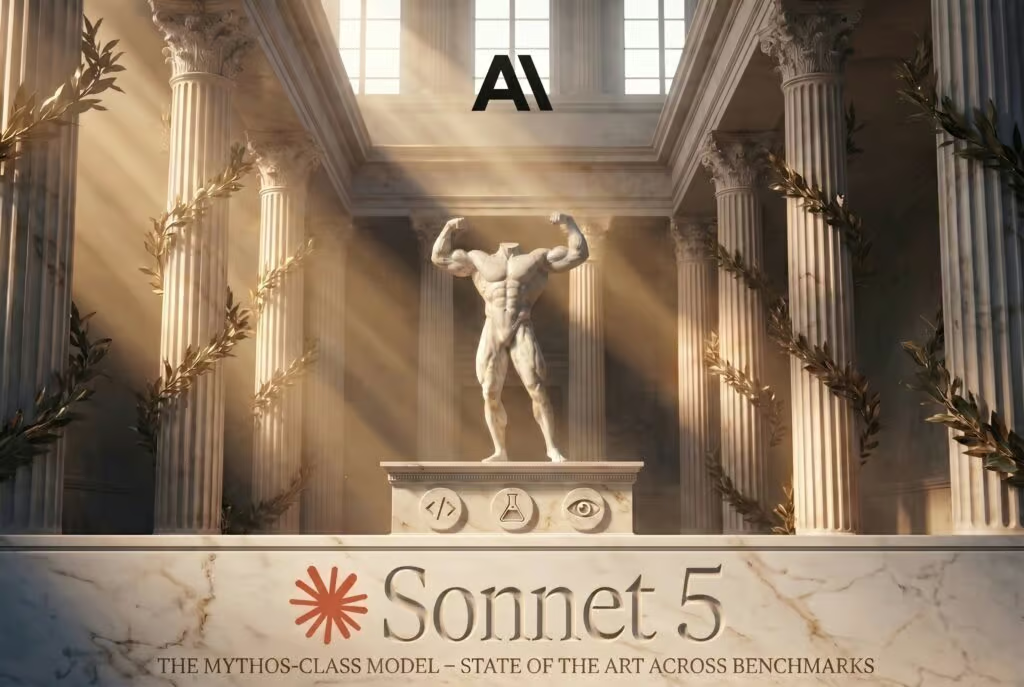
Claude Sonnet 5 launched this week, positioned by Anthropic as a cheaper, faster alternative to Opus 4.8 rather than a major capability leap. Frontier labs are meanwhile navigating an ad hoc licensing regime and a broader “Mythos Moment,” with several policy questions coming into sharper focus.
Comparative Regulation: The U.S. vs. China
Daniel Eth noted that the U.S. now places more restrictions on its frontier AI than China does. The more useful framing: regulation matters most when a model is near the frontier. Producing Chinese-level results domestically means regulatory constraints are minimal. This doesn’t validate current U.S. restrictions, but it does put them in perspective.
DeepMind, the Pentagon, and the Limits of Internal Safety Culture
Andreas Kirsch argues that DeepMind’s bet on trust-based safety culture failed under real pressure. The Pentagon contract contained enough ambiguous language to give the government full leverage, meaning internal objections and employee petitions carried little weight. Kirsch and UTAW/CWU are now pursuing union recognition so employees can exercise real leverage, including striking or resigning collectively, in future confrontations.
What does the AI Incident Reporting Act actually do?
Charlie Bullock highlighted the AI Incident Reporting Act, introduced by Rep. Nate Moran (R-TX). Bullock praised its handling of preemption and its capabilities-based threshold for covered models, while noting that such thresholds are inherently tricky to implement.
The “Good Guy with an AI” Problem
The gun-rights analogy fails when applied to AI safety. As Sophia Cai and Ben Johansen reported, the argument that good actors need access to the same models as bad actors misunderstands the threat model. Ideally, defenders should hold a superior model, because equalized access lets attackers scale damage before defenders can patch. The talent deficit that previously favored defense shrinks when AI automates offensive capabilities. Claims that offense-defense balance favors defense “at the limit” are speculative; realistic defensive optimism requires deliberate policy choices, not automatic equilibrium.
The Judiciary as AI Regulator
With the Executive Branch acting unilaterally and Congress gridlocked, Dean W. Ball argues courts will resolve the most consequential AI questions, and that the First Amendment is the framework they’ll use. He calls for moving past “code is speech” rhetoric toward concrete legal theories about which fact patterns demonstrate protected expression. Ball’s concern: the First Amendment will limit state intervention in ways that make alignment regulation difficult. The counterargument: if courts rule that models are speech, the government will simply restrict training and access upstream rather than use. Sooner or later, the state uses the tools it has.
Models as Speech
Preston Byrne and others argue that LLM use is expressive conduct protected by the First Amendment. Taken to its logical extreme, the government cannot control how people use models once they exist. The likely response: preventing training of sufficiently advanced models, or restricting who can access and run them. If independent regulators become impossible, the alternative isn’t no regulation; it’s politically dependent regulation.
How does Slaughter v. Trump affect independent AI oversight?
The 6-3 ruling in Slaughter v. Trump, which overruled Humphrey’s Executor, makes independent AI oversight significantly harder. Ben Rossen explains that any frontier AI commission with licensing authority, evaluation power, or deployment restrictions would now be vulnerable to at-will presidential removal, since the Court treated substantive rulemaking, investigations, and enforcement as executive power. Dean Ball welcomes this development, arguing we should strip away the fiction of nonpartisan agencies and acknowledge their partisan nature. The counterargument: even a partial norm of nonpartisanship, imperfectly enforced, mitigates damage. Openly partisan financial and speech regulators would corrode institutional legitimacy in ways that compound over time.
Open-Weight Models and Distillation
The debate over open-weight model safety continues, with some arguing that open-weight models are inherently unsafe and nothing can fix this. The more productive question is what “banning open source” would actually mean in practice, given global development, distillation techniques, and the difficulty of enforcing model-weight restrictions across jurisdictions.
What Comes Next
Two frontier releases are anticipated: Claude Fable 5 and GPT-5.6-Sol. In the meantime, the policy landscape is being shaped by executive action, judicial doctrine, and the practical impossibility of Congressional consensus on AI governance.
FAQ
What did Anthropic announce this week?
Anthropic released Claude Sonnet 5, positioning it as a cheaper, faster alternative to Opus 4.8 rather than a major capability leap.
Why does the DeepMind-Pentagon dispute matter for AI policy?
Andreas Kirsch argues the case shows that trust-based internal safety culture failed under real pressure, since ambiguous Pentagon contract language gave the government full leverage. Kirsch and UTAW/CWU are pursuing union recognition so employees can strike or resign collectively in future confrontations.
How does Slaughter v. Trump change AI oversight?
The 6-3 ruling overruling Humphrey’s Executor exposes any frontier AI commission with licensing authority, evaluation power, or deployment restrictions to at-will presidential removal, since the Court treated substantive rulemaking, investigations, and enforcement as executive power.