Microsoft launches MAI-Cyber-1-Flash inside MDASH, a cost-cut vulnerability hunting system
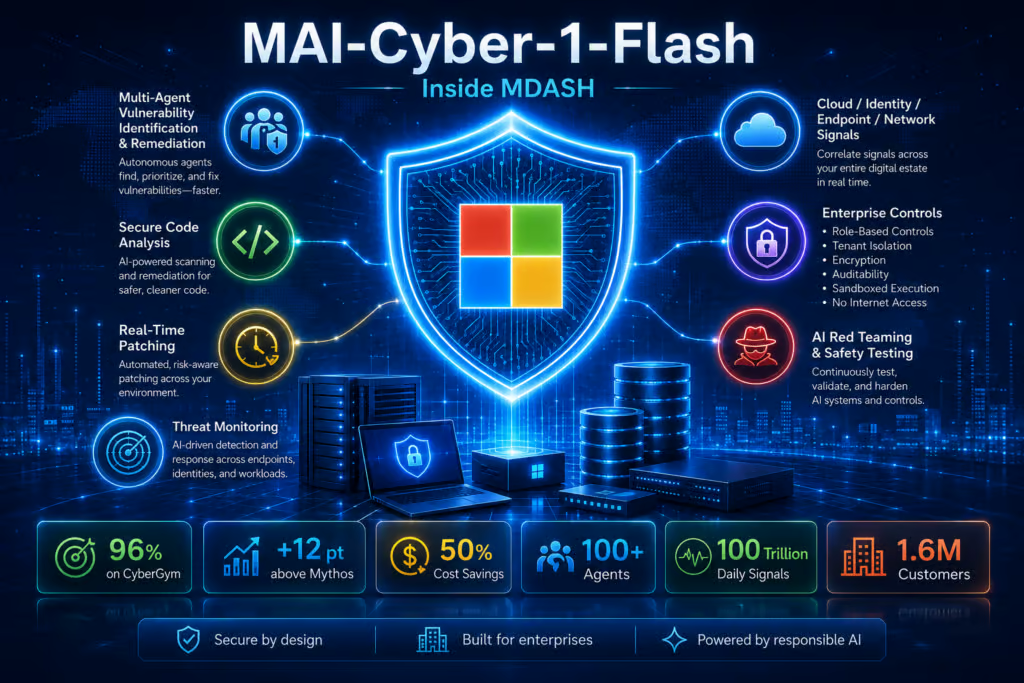
Microsoft has launched MAI-Cyber-1-Flash, a compact security-focused language model, and embedded it inside MDASH, the company’s multi-agent vulnerability identification and remediation harness. The combined system is reported to score 96% on the CyberGym benchmark, 12 percentage points above Mythos, while cutting the token cost of vulnerability scanning by roughly 50% compared with Microsoft’s prior GPT-5.4 plus 5.4 mini plus 5.3 codex stack.
What is MAI-Cyber-1-Flash?
MAI-Cyber-1-Flash is a code-heavy model derived from the MAI-Thinking-1 lineage, built from scratch in-house and trained on what Microsoft describes as its highest quality data. According to the announcement, the model is designed to handle up to 90% of the tasks that arrive in a security pipeline. The remaining 10%, the work items the company characterizes as exceptionally hard, are routed to larger and more expensive models in the same fleet, including GPT-5.4.
This routing is what produces the headline cost figure: by reserving frontier-tier compute for the hardest cases and offloading routine analysis to MAI-Cyber-1-Flash, the MDASH harness runs at 50% of the cost of the prior configuration. Microsoft frames token cost, rather than raw model intelligence, as the binding constraint for defenders facing an always-on threat environment.
How does MDASH put the model to work?
MDASH is a multi-agent harness tuned by cybersecurity practitioners. The system uses more than 100 agents drawn from multiple leading models to find, validate, and remediate vulnerabilities in large codebases. Its work feeds what the announcement calls Project Perception, a new agentic security system that Microsoft is also launching in parallel.
Perception supplies teams of agents for several security workflows inside MDASH, continuously monitoring, patching, and closing new threat vectors. Microsoft states that Perception will soon begin using MAI-Cyber-1-Flash for security workflows beyond software vulnerability work, though the announcement does not specify a date or a list of additional workflows.
What did the CyberGym evaluation show?
CyberGym is described in the announcement as the gold standard benchmark for evaluating how systems reason over large codebases to find real vulnerabilities in code. The reported numbers are:
- MAI-Cyber-1-Flash inside MDASH: 96% on CyberGym.
- Margin against Mythos: plus 12 percentage points.
- Comparison group: the announcement claims the system beats Mythos, Gemini, and GPT on the same benchmark.
The source does not provide standalone leaderboard tables for Gemini or GPT, so the relative margin against those systems is not quantified beyond the claim of beating them. A technical report on MAI-Cyber-1-Flash is referenced for additional model-level detail, but its contents are not reproduced in the announcement.
What data does the system train on?
Microsoft points to three reinforcing components, which it labels Model, Data, and Harness. On the Data side, the company cites decades of operating security products, which it says now produce more than 100 trillion security signals each day across identity, endpoint, cloud, data, browser, and applications, drawn from a base of 1.6 million customers. That stream feeds back into what Microsoft calls a live reinforcement learning loop, in which investigations, triage decisions, hunts, remediations, and the outcomes of those actions are continuously converted into training signal for cyber models.
The announcement positions this historical record of real exploits and remediations as the structural advantage competitors cannot replicate, framing it as decades of accumulated ground truth rather than a static dataset.
What safety and governance controls ship with the system?
Because MAI-Cyber-1-Flash is Microsoft’s first cyber model, the announcement devotes a section to layered safeguards. According to the post, the model was developed with a security-first calibration, evaluated by Microsoft’s AI Red Team, and tested through automated and expert-led adversarial exercises. A third-party assessor also independently reviewed the system.
At the deployment layer, MDASH offers enterprise-grade controls that include Role-Based Controls, tenant isolation, encryption, auditability, and sandboxed execution environments with no internet access. The framing throughout the section is that defenders gain capability while enterprises retain the governance and control they expect from a Microsoft security product.
Why is a multi-model architecture the central design choice?
The decision to route the bulk of work to MAI-Cyber-1-Flash and reserve GPT-5.4 for the hardest cases reflects a broader shift in how security stacks are being assembled. Rather than relying on a single largest model for every job, MDASH treats the model fleet as a tiered resource: a lightweight, code-heavy specialist handles the routine majority, and a more expensive generalist handles the long tail. The 50% cost figure is the clearest expression of that trade-off in numeric terms.
The announcement also ties this architecture to reinforcement learning from production telemetry. By connecting actions to outcomes across Microsoft’s security estate, including contributions from the Microsoft Security Response Center, the system aims to keep improving as defenders investigate, triage, and remediate at scale.
FAQ
What is MAI-Cyber-1-Flash?
MAI-Cyber-1-Flash is a compact, code-heavy security model derived from the MAI-Thinking-1 lineage and built in-house. It is designed to find challenging vulnerabilities in complex codebases and to handle up to 90% of the tasks in a security pipeline when routed inside MDASH.
How does it perform on CyberGym?
The combined MDASH plus MAI-Cyber-1-Flash system scores 96% on CyberGym, which the announcement describes as 12 percentage points above Mythos. The announcement also claims the system beats Gemini and GPT on the benchmark, without publishing standalone margins against those models.
How much cheaper is the new configuration?
Microsoft states that MDASH using MAI-Cyber-1-Flash runs at 50% of the cost of its prior configuration, which used GPT-5.4, 5.4 mini, and 5.3 codex. The savings come from routing most work to the lighter MAI-Cyber-1-Flash while reserving GPT-5.4 for roughly the hardest 10% of tasks.
This article summarizes reporting from microsoft.ai.