A $500M Claude Bill: The AI Spending Guardrails Every Enterprise Needs
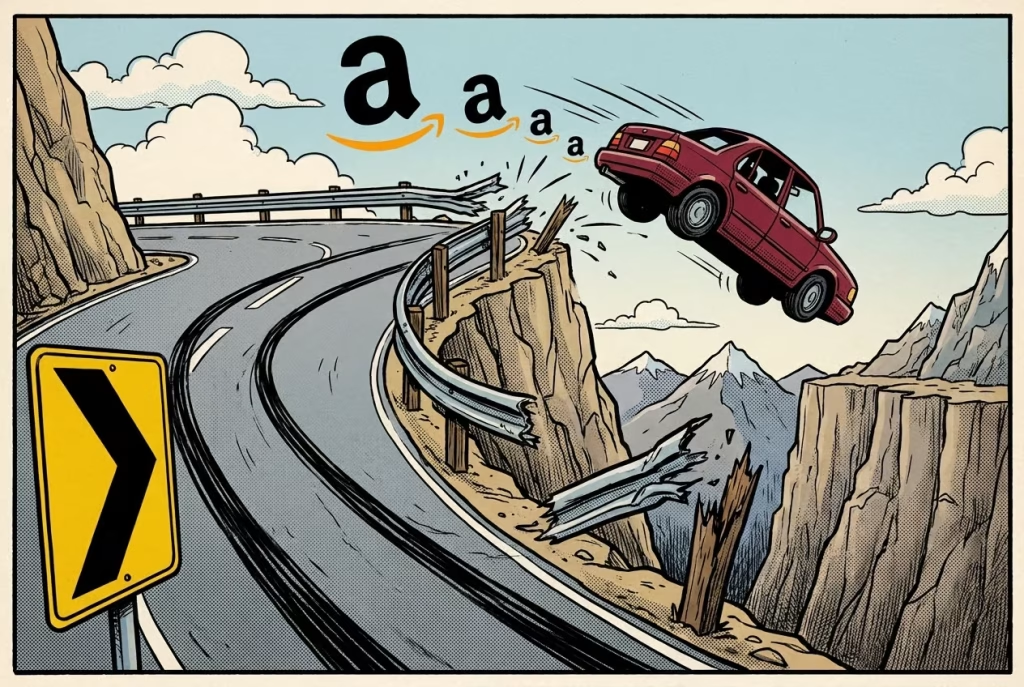
An enterprise client of Anthropic, widely suspected to be Amazon, reportedly ran up roughly $500 million in Claude charges in a single month after failing to set usage limits on employee licenses. The figure, surfaced by an AI consultant, is a story about what happens when a company deploys a usage-billed AI tool to thousands of employees without the spending controls that every enterprise platform already provides.
How a Half-Billion-Dollar Bill Happens
Amazon has one of the deepest financial relationships with Anthropic of any company. It has invested $8 billion, announced another $5 billion in April 2026 with the potential for up to $20 billion more tied to milestones, and Anthropic has committed to spending more than $100 billion over ten years on AWS. Internally, Amazon pushed aggressive adoption: more than 80 percent of its developers were expected to use AI tools weekly, with internal leaderboards tracking usage.
According to the reporting, employees used an internal agent tool called MeshClaw to route non-essential tasks through AI, and a leaderboard nicknamed KiroRank awarded points to the heaviest token users. Employees did the rational thing when usage itself became the scoreboard: they generated more of it. Management eventually had to tell staff to stop, and the reported $500 million bill landed around the same time.
What Is the Structural Risk Underneath?
The individual story is dramatic, but the underlying dynamic is what should concern any company scaling AI. The AI industry increasingly runs on circular money flows. Hyperscalers invest billions in model companies, model companies commit billions back to hyperscaler cloud, enterprises push employees toward the tools, rising usage supports higher revenue projections, and those projections justify the next round of infrastructure spending.
In that loop, inflated token counts look like demand on paper, for everyone, until the invoice arrives. Analysts have flagged that explosive AI revenue growth may tell only half the story, with early signs of corporate AI fatigue emerging even as projections climb. A bill of this size is the point where the abstraction of “adoption” becomes a concrete, payable number.
Which Other Companies Hit the Same Wall?
Several large companies have hit the same wall in different ways:
- Meta built an internal “Claudeonomics” dashboard ranking top AI token users, then killed it after employees began competing to top the rankings.
- Microsoft reportedly canceled most Claude Code licenses and shifted developers to GitHub Copilot CLI.
- Uber reportedly exhausted its entire 2026 AI coding-tools budget by April, with its COO admitting the cost-to-value line is “very hard to draw.”
The common thread is not a bad product. It is the absence of governance around a tool that bills by consumption and was rolled out faster than the controls to manage it.
What Guardrails Does Every Organization Need?
The fixes are unglamorous and well within reach of any company on an enterprise AI plan. They should be set before rollout, not after the first surprising invoice.
Set per-user and organization spending limits
Every major enterprise AI platform supports per-seat caps. Set a sensible default per user per month, require manager approval for higher limits, and put a hard ceiling on total organizational spend so no single failure can produce a runaway bill.
Monitor without gamification
Track token usage as an operational cost metric, not a performance score. Never build a leaderboard around raw consumption. Review anomalous usage patterns on a regular cadence so spikes are caught in days, not at month-end.
Write an explicit “good use” policy
Define what legitimate use looks like (code generation, drafting, analysis) and what wasteful use looks like (routing busywork through AI, unnecessary task multiplication). Make the consequences for gaming the system clear.
Pilot before you scale
Before rolling AI out to thousands of employees, pilot with a small group and measure the things that matter: actual productivity gains, token cost per unit of real output, and whether adoption translates into business outcomes. A model that quantifies value at 50 users protects you at 5,000.
Budget for a 10x variance
If your adoption plan does not account for at least a tenfold difference between best-case and worst-case spend, the budget is not realistic. Usage-based pricing has a long tail, and the tail is where the headlines come from.
The Takeaway
The $500 million figure is a punchline, but the lesson is mundane and important. The companies that get AI right will not be the ones spending the most on tokens. They will be the ones that install guardrails before granting unlimited access, that track outcomes rather than consumption, and that treat AI as a tool to be governed rather than a metric to be maximized. The mystery bill was not a failure of the technology. It was a failure of management, and management failures are the kind you can prevent.